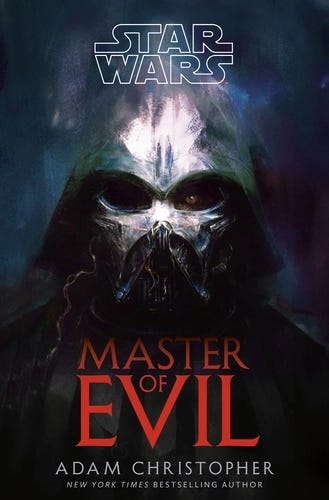
Master of Evil
by Adam Christopher

Before getting into what Master of Evil does well, and it does several things well, this review is best framed as a warning to potential readers.
If you are picking up this book expecting a true, in-depth, Vader-centered story, you may be disappointed.
Despite the title, Vader is important but he’s not the lead. He is powerful and he looms over the narrative. But he is not the emotional narrative heart of the story.
The easiest way to understand this book’s structure is to compare it to horror franchises and how they portray the monster. Vader is the monster in this book.
Like Friday the 13th, Jason Voorhees is the central figure but he is not the emotional lead. The story is usually told through other characters who are affected by him, threatened by him and trying to survive.
The “monster” is ever-present, but rarely the viewpoint. That is exactly how Vader functions in Master of Evil. He is terrifying. He is impressive. He dominates every scene he enters. But much of the story is told around him rather than through him. We see how others respond to his presence, fear him, interpret him, and try to navigate his shadow. If you go in expecting deep, sustained access to Vader’s inner life, this framing may feel misleading.
Instead, the novel’s real emotional and narrative core lies elsewhere. Halland Goth’s storyline is the most engaging part of the book. His perspective provides the tension, momentum, and human stakes that Vader’s fixed role cannot. Where Vader is static by necessity, Goth is capable of doubt, curiosity, ambition, and uncertainty. That flexibility makes his arc far more compelling.
The mysterious artifact itself is well conceived: strange, ominous, and layered with unanswered questions. Christopher does an excellent job building intrigue around it. The slow unveiling of its nature and purpose gives the novel much of its forward drive.
This sense of mystery is where the book is at its best. It fits perfectly with the gothic tone Christopher is aiming for. It feels appropriately “Star Wars,” while also leaning into darker, more mystical territory.
Through Goth, the reader experiences that mystery in a grounded way. His reactions feel authentic. His curiosity feels earned. His vulnerability makes the stakes feel real. In many ways, he is the character you end up caring about most.
This leads to the book’s biggest structural issue: expectations.
Calling this novel Master of Evil and using Vader in its marketing creates a promise that the story does not fully keep. It suggests a definitive Vader character study, when in reality the book is closer to a story about living under Vader’s rule.
Because of this, the reading experience can feel slightly off-balance. You keep waiting for the story to become “Vader’s book,” and it never quite does.
If this book had been titled something like The Royal Guard, and if the cover had featured Goth instead of Vader, expectations would have shifted. Readers would approach it as a story about an Imperial navigating danger, power, and dark side influence with Vader as a looming presence rather than the focus. Framed that way, the novel works extremely well.
I will say the gothic atmosphere is rich and effective. The Empire feels less like a smooth military machine and more like a haunted institution propped up by fear and ritual. Even when the plot slows, the mood remains engaging.
To be clear, Vader is not poorly written.
Christopher understands the character. Vader is portrayed as cruel, disciplined, obsessed with control, and deeply embedded in Sith ideology. His relationship to pain and power feels authentic. His presence is always intimidating.
The problem is not quality, it’s limitation.
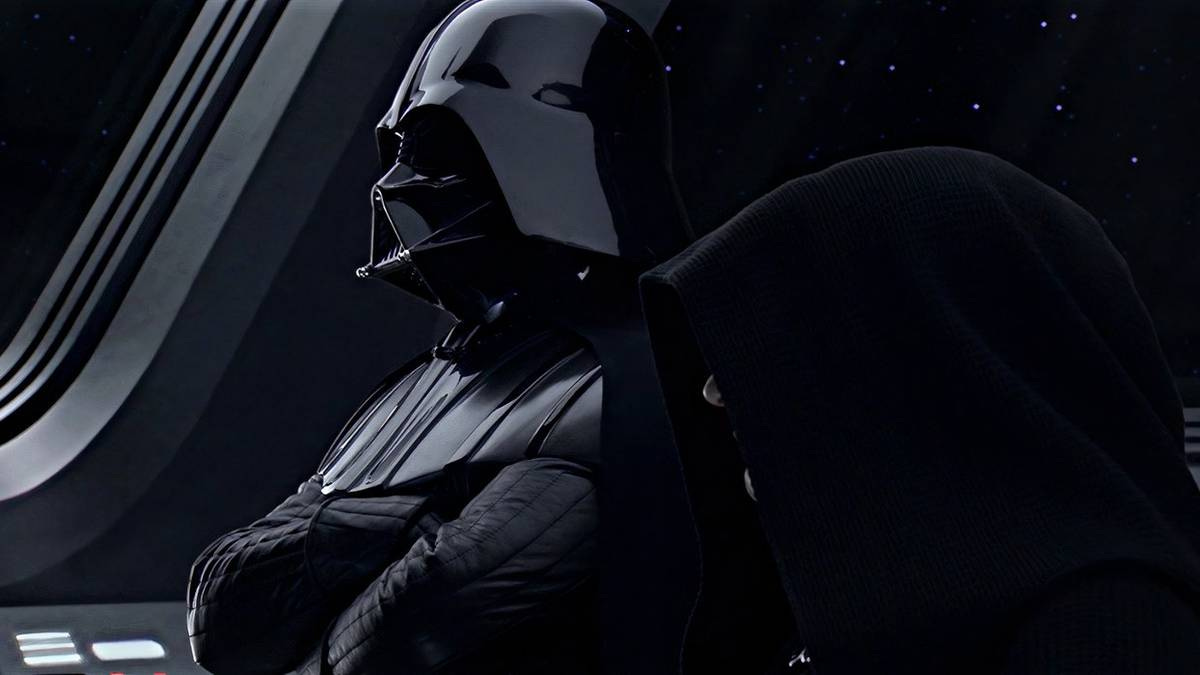
Vader’s arc is so firmly established by canon, the novel cannot push him very far. He cannot meaningfully grow, collapse, or transform. He exists to reinforce his existing identity. They are well done. They are just not especially surprising.
One of the book’s most successful elements is how it handles mystery.
The artifact is not treated as a simple MacGuffin. It has history, symbolism, and spiritual weight. Its connection to the dark side feels dangerous in a way that goes beyond simple “evil power source”.
Star Wars: Master of Evil is a good novel. A very good novel.
It is atmospheric, well written, and often engaging. Goth’s narrative is compelling. The artifact is intriguing. The gothic tone is consistently strong. Vader is portrayed with skill and respect. But it is also a book that can easily disappoint if approached with the wrong expectations.
This is not a definitive Vader novel. It is a story about existing in Vader’s orbit. If you go in expecting a monster style storytelling, where Vader is the unstoppable presence rather than the emotional lead, you will likely enjoy it more. If you go in hoping for a deeply personal Vader journey, you may feel let down.
Ultimately, this feels like a case where a different title, a different cover, and a different marketing focus could have transformed reception. Presented as Goth’s story, this novel shines. Presented as Vader’s, it feels like a missed opportunity.
So consider this less a condemnation and more a warning:
Read it but know what kind of book it really is before you start.